

Vae Victis
Act 3, Chapter 3 of The Ashes of Rome

Welcome to the final installment of my serial, The Ashes of Rome. It takes place around 390 BCE as the Senones and Rome clash.
Previously: The Senones attempted a stealth attack on the Capitoline Hill, but were repulsed.
Now: The Senones get some bad news but devise a plan to extract themselves from Rome.
Make sure you’re subscribed to get each installment in your inbox.
#/media/File:Brennus_and_Camillus.jpg)
Smoke coiled above the city, black and noxious. I took grim satisfaction that it lay the thickest over the Capitoline Hill. Let the damned Romans choke on the stench of our burning dead, the bastards.
Brennus saw where my attention lay. “My only consolation is that I know that while we’re dying of marsh fever, the Romans are up there dying of starvation.”
“Much more of this, and the carrion crows will be the only ones enjoying the spoils of Rome.”
After the unsuccessful stealth attack, we had settled into the siege, which meant no resupply could reach the Romans on top of their hill. However, our supplies were also low, and nothing remained within a day’s march of the city’s walls. We also discovered one of Rome’s less obvious defences: disease. Marsh fever1 ran rampant through our ranks, and many died. Rather than leave the corpses to fester, we burned them, like we were doing now.
“Messenger coming!” someone shouted. Brennus and I turned to see what was happening. A tall, lean warrior stomped through the Forum toward us. Dark circles beneath his eyes bespoke sleepless nights on the road south.
“Who comes?” I called out.
“Actinus, son of Ategnatos.”
“Welcome to Rome,” Brennus greeted him. “What word from home?”
“Bleak news, Brennus. The Veneti2 make war on us, and with most of our warriors here in the south, things go badly.”
“How badly?”
“We are hard-pressed to hold them at bay. While we have the better warriors, their numbers give them the advantage. Our people call for you to return.”
Brennus barked harsh laughter. “And abandon our efforts here? The Romans still have not paid for their betrayal at Clusium.”
“What matters more, Brennus? Your retribution or our lives?”
“You suggest that I put my personal matters over the good of the tribe?” Brennus’s voice was deadly quiet.
Perhaps sensing that he’d overstepped, the warrior tried to backpedal. “No one would say such a thing,” he said quickly, bowing his head. “It’s only that your people’s need is great. If we are to keep what lands we’ve won in Italia, you must make haste.”
“Perhaps there’s a solution that will uphold Brennus’s honor and send us speedily home to face this new threat,” I suggested. Both Brennus and Actinus gave me their full attention.
“It seems to me that the situation atop the hill must be graver for them than us, and Rome would likely jump at the opportunity to be rid of us.”
“I’m sure they would, but what are you suggesting?” Brennus asked.
“Why don’t we give them the chance?” The glint in my eye must have clued Brennus in to my plan.
“A ransom!”
“Exactly. We convince the Romans that we’ll leave for the right price. They get their city back, we get the gold, and our people get the relief forces they need.”
Actinus burst out laughing. “You’re going to make them pay you to leave when you plan to leave anyway. Devious!”
“Now, we just need to decide how much it will take to buy us off.” Brennus’s grin was evil.
✸✸✸
“How do I get talked into these things?” I muttered aloud.
“It was your idea,” Urus replied.
“Must you remind me?”
Together, Urus and I climbed the road to the gate atop the Capitoline Hill. Urus carried an olive branch held high3, and neither of us bore weapons or shields.
“How did you convince Catta to let you go?”
“What Catta doesn’t know won’t hurt me until I get back.”
“Aha! You snuck out. She’ll skin you alive. You’ll be lucky if you can walk back home when she’s done with you.”
I grimaced. I did not need a reminder of that. It was not so much that Catta worried for my safety, although she did. She would be most incensed that I’d taken Urus to meet the Romans rather than her. However, for my plan to work, she needed to be in camp when Brennus sat down with the Roman negotiator.
“Are you really going to trust that these bastards will honor the negotiations? You do remember Clusium, don’t you?”
I glared at Urus. “I was there, same as you. Now, do you plan to chatter like a chipmunk the entire way, or can we have some silence?”
Urus frowned at me but closed his mouth.
“Praise all the gods,” I muttered. I felt bad for scolding the big aurochs, but only so much. If this was to work, I needed to deliver my speech perfectly, and answering Urus’s endless litany of questions would not help.
The gate loomed before us. “Hoist that branch as high as you can. I’d rather not get a javelin through my face if I can avoid it.” Urus did as I asked, holding the branch and waving it back and forth.
“Hail the gate!” I shouted.
Silence was the only answer.
“Hail the gate! I bring a message from our war chief for your leaders!”
“Your accent is terrible, barbarian!” a tired-sounding voice called back. At least it was an answer of sorts. “What does your mongrel chieftain want?”
“I was instructed to give my message only to the Tribune Quintus Sulpicius Longus.”
“So that you may slay him out of hand? No, we know your tricks.”
“Listen, little man,” Urus began. I knew exactly where this was likely to go, and it was not where we needed it. I elbowed him in the side sharply.
“Ow!” he yelped. “What was that for?”
“If you finish that threat, we’ll be poked full of holes rather quickly, and this message will go undelivered.”
Urus kicked a stone across the road. “Well enough. It’s just that there’s been precious little fighting since that little dust-up by the river.”
“Just think of all the Veneti warriors you can fight when we get back home.”
Urus brightened at that.
I returned my attention to the unseen guard behind the gate. “We need not even see him directly. Open your gate sufficient that we can identify that it is truly him, and we’ll deliver our message. You can see that we’re not armed.”
The gate creaked open two handspans. Through the gap, I could see several soldiers, their flesh thin and their cheeks sallow. One stepped forward. “I’m Quintus Sulpicius Longus. What does Brennus want?”
“To parley, I believe,” I replied, thrusting the scroll through the gap in the gate.
The Roman took it, unrolled it, and quickly scanned the contents. His head snapped up when he finished. “Do you know what this says?”
“Most of it,” I lied. Brennus and I had penned it together.
“Does he mean what he says? You’ll leave?”
“He does, and we will, but the timing and the manner of our departure depend very much on the outcome of your discussion with him. I believe the terms are explained in the message.”
He looked at the scroll again. “Tomorrow morning in the Forum. Does Brennus take me for a fool? As soon as I set foot off this hill, you barbarians will kill me out of hand.”
“I’m to personally guarantee your safety to the meeting and back to the gate,” I explained.
“Well, let me tell you how much that assuages my concern.”
“So, should I carry your rejection back to Brennus?”
“Not at all. If it means ridding my city of you bastards, I’d crawl naked down the causeway on my hands and knees.”
✸✸✸
I stifled a yawn while Urus rubbed at his eyes. The sun had crested the eastern horizon nearly an hour before, and still we stood before the gate waiting for the Romans.
“What’s keeping them?” Urus wanted to know.
“The gods only know. You would think they would be in more of a hurry.”
Just then, the gates creaked open. Quintus stood there, along with two soldiers. All three were armed, which was allowed by our terms; anything to put them a little more at ease. Now we just had to get them down the hill, through the meeting, and back again.
“Tribune,” I greeted Quentis.
“Lead on that we may get this over with.”
Quintus and his bodyguards fell in line. I led the way, with Urus bringing up the rear. It took little time to reach the Forum, although we could hear it long before we saw it. So far, so good. Coming to the bottom of the hill, the Forum spread out before us. Senone warriors stood, sat, and lounged everywhere. We’d chosen our strongest warriors and placed them front and center.
Food was likewise ubiquitous. I shuddered at the thought of so much of our meager supply being used in this way. Haunches of venison, crusty loaves of bread, smoked fish, cheeses, and porridge all made their appearances. The aromas were enough to set my mouth salivating. In the center of it all, Brennus sat in state, surrounded by warriors. However, these were not just any fighters. Catta, Boudia, Abbula, and several other women stood around him, their faces painted in fierce colors, and their weapons at the ready.
“By the gods,” one of the bodyguards muttered, his stomach growling loudly. “So much!”
“Ware the wild women!” the other bodyguard called. “They’re more dangerous than the men by half.”4
“Why do you think Brennus surrounds himself with them?” I asked. “Only the fiercest of the fierce. I’ve seen at least one of them rip out a man’s liver and eat it before his dying eyes.” At that moment, Catta raised her spear and snarled at the Romans. The bodyguard clutched his pilum tightly.
“Yes, quite the display you’ve put on here,” Quintus said, eyeing the food and women with equal wariness.
“Come, sit and eat.” I motioned for them to follow me to where a seat had been prepared for the tribune. Quintus seated himself and smiled wryly when he realized that his chair was much lower than Brennus’s.
“You set quite the table,” he said as one of his soldiers set a platter of food in front of him, before going to fill his own.
Brennus spread his arms. “Guests must be honored, no? And if we have the means to fill your bellies, why stint?”
“Indeed,” was all Quintus said. He ate sparingly, unwilling to show us his weakness, but I could tell from his movements that it took all his willpower not to shove as much food into his mouth at one time as possible. His bodyguards suffered from no such compunction. They crammed meat and bread and cheese into their gullets with abandon, starving men with no idea when they might see such bounty again.
“Wine!” Brennus shouted, and someone brought cups and amphorae, then poured liberally for our guests. The bodyguards once again indulged. Quintus sipped at his, grimacing.
Brennus laughed at his discomfiture. “We don’t water our wine, Roman. Full strength, as the gods intended!”5
Quintus’s smile did not reach his eyes. “You truly are barbarians.”
That brought another laugh from Brennus, but I could see the tension in the set of his jaw and the angle of his shoulders. So much rode on this parley.
“Well, what is it that you wish to discuss?” Quintus asked.
Brennus leaned forward in his seat, looking down at the Roman. “I’d like to discuss terms for our withdrawal.”
“So, you truly plan to leave.”
“If you’re amenable, yes. If not, we’ll stay the course.” He leaned back in the chair, lounging indolently. “Although I cannot see why you would disagree. How many of your troops have died of starvation already? As you can see, we’re well supplied, and our warriors are strong and ready. We can drag this on for another seven months if need be.”
A seasoned politician, he might have been, but I could see the thoughts churning inside Quintus’s head just as clearly as I could see his cheekbones jutting through paper-thin flesh.
“What are your terms?”
✸✸✸
“How much did he finally agree to?” Urus asked.
“A thousand pounds of gold.” I still found it hard to credit, but Quintus had departed with that agreement. The Romans would pay us, and in return, we would quit the city and return north to fight the Veneti. As far as I could see, everyone got what they wanted, although the Romans would come out of it considerably poorer.
Urus whistled appreciatively. “And that’s on top of what we’ve already taken from the homes and temples?”
“You think Brennus would listen if they demanded that we put it back?”
That got a laugh from the big man, which pleased me. Things had been bleak with the deaths of so many friends, and both Urus and I felt their loss keenly. Garamaros, Iestinus, and Lukotorix all had gone on to their next lives. So many familiar faces were missing. It would be a changed army that marched home.
“How did he convince him?”
“How does any marketplace deal get made? Brennus started with an amount he knew Quintus would laugh at, and then they haggled from there.”
The arrival of the Romans cut our conversation short. Quintus led a delegation of other politicians and a small retinue of guards down from the Capitoline Hill. I had to admit that they looked very fine in their robes and ceremonial armor. Behind them came several wagons laden with coins, gold idols, temple artifacts, and jewelry.
One of the soldiers caught my eye and sneered. Something about his face was familiar, but I could not place him exactly. Then I remembered. He’d been one of those nearby at Garmaros’s death. I had a momentary vision of his face above a shield, eyes wide with fear as I slaughtered his comrades. I grinned at him, and the sneer faded. Yes, taking their gold would be an absolute pleasure.
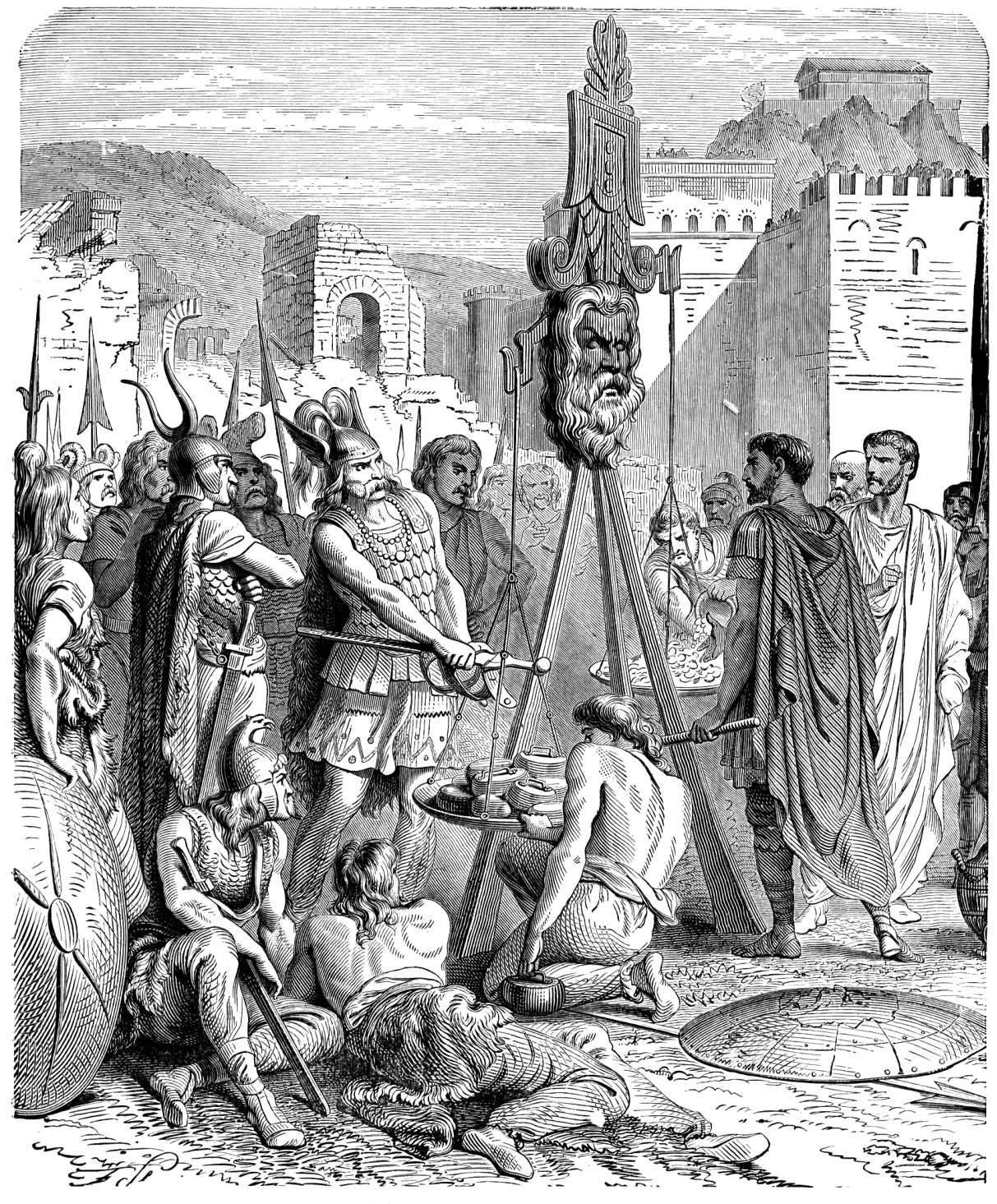
Quintus led his people to the center of the Forum, where Brennus had told us to erect the scales. Two metal baskets hung suspended by chains from a central arm. One would hold the weights and the other would hold the Romans’ gold. As the Romans filed in, Urus and I went to join Brennus at the scale.
“Tribune, I’m grateful to see that you intend to honor our agreement.”
“Rome always lives up to her promises,” Quintus shot back.
“Not in my experience. This entire affair could have been avoided had Rome done what she should have done from the very beginning. These are the fruits of your people’s actions, never forget.”
“The Fabii were duly elected by—”
“Spare me your lies, Tribune. We both know that they broke the most sacred of laws. My brother’s death came at the hands of one of your so-called ‘impartial negotiators’. Even then, we sought redress with the people of Rome, but you would rather elect liars and betrayers to positions of honor.”
One of the Roman soldiers reached for his sword hilt and stepped forward in defense of his tribune. I straight-armed him to a halt, but anger simmered in his eyes.
“Peace, friend,” I said.
“I am no friend of yours, murdering barbarian.” He spat the last word like an epithet. Several other Romans edged toward us, ready for violence.
“I may be a barbarian, friend, but I am not the one with my head on the block. If that blade clears its scabbard, more lives than your own are forfeit. Would you be the death of your tribune and all your fellows?”
He glanced around and seemed to notice the thousand or so Senone warriors who surrounded the Forum’s heart for the first time. Behind them ranged the rest of our forces. The cords stood out in his neck, and his arm shook with suppressed rage, but he moved his hand away from his sword hilt.
“Very smart.”
“Lucas, help load the gold onto the scales,” someone called. The soldier gave me one last look, then went to lend a hand.
“Urus,” Brennus called. “Place our weights onto the scale, if you please.”
“Stop right there!” Quintus ordered. “Do you believe that we would willingly let you swindle us? You’re using false weights!”
“There’s nothing wrong with them. If you feel that strongly about it, you can march back up the hill, and we’ll resume the siege,” Brennus said. “Urus, continue.”
The big man continued loading weights onto the scale, but Quintus was not finished yet. “We have our own weights to ensure an honest transaction.”
Brennus threw back his head and laughed. “Honesty? From a Roman? Do not take me for a fool.” He unbuckled his belt and threw sword, scabbard, belt, and all onto the scale.
“What is that supposed to mean?” Quintus asked.
“Vae victis!”6 Brennus growled.
A roar of approval went up from the gathered Senones that shook the very heavens. Furious, Quintus stared helplessly as we weighed the gold and then loaded it into our own carts for the journey home. A familiar dark-haired figure in the gathered throng caught my eye, and I laughed to myself.
“What’s so funny?” Urus asked.
“Let’s just say that Clutoidā offers glory in more ways than direct battle.”
Urus shook his head. “Whatever you say, Talos. Now, care to lend me a hand? All this gold is heavy.”
I laughed again, but lent him a hand. In a surprisingly short amount of time, we had the gold loaded along with the bounty we’d taken from the city. Camp was struck, and we were ready to return north to defend our homes against the invading Veneti. As we marched out of Rome, Quintus Sulpicius Longus and his men stood on the causeway to the Capitoline Hill and watched us leave.
THE END
Thanks for going on this journey with me. When I first started this, what seems like years ago, I had a rough idea of how the story would flow based on historical accounts, but the people who populate it were still a mystery to me. I’ve greatly enjoyed getting to know them all over the course of the last several months, and I hope that you have, too.
While this is the end of the story, it’s not quite the end of the project. I plan to write a behind-the-scenes post that digs a bit more into what we actually know (and don’t know) about the whole thing, as well as address some missing elements that some of you might have noticed (where the hell is Marcus Furius Camillus?).
Thanks for reading! I’m grateful that you’re here.
Now that you’re caught up on The Ashes of Rome, why not try something else?
The Stone in the Forest, a folk-horror story.
A Dread Tide Rising is my serialized, pulp-flavored, epic fantasy novel. You can read for free at the link as chapters drop, or buy the book (Amazon | Other Platforms).
Or check out more of my historical fiction work here.
✸ YOUR support powers Blackspire! ✸
Enjoying my work? Drop a one-time tip in the Tip Jar. You can also like, share, comment, and restack the post to update the algorithm and help this story find its audience!
Rome is a city of hills and valleys. The central area where the Forum was built is very low in elevation and was originally a wetland. It was drained in the 7th century BCE, but malaria from mosquitoes remained a problem.
There are multiple tribes named “Veneti” in history, including one very well attested Gaulish tribe in what is today Brittany that gained recognition as a sea power. However, this tribe was most likely Italic or Gallo-Italic.
The Senones would most likely have used mistletoe as a truce token, but the Romans would not have known what that meant. They copied the Greeks (as in so many other things) and used the olive branch as their symbol of peace.
While the Greeks and Romans were terrified of Celtic men, they were particularly shocked by their women. Here’s a description from the History of Ammianus Marcellinus, apparently after witnessing Gaulish women kickboxing:
§ 1. Nearly all the Gauls are of a lofty stature, fair, and of ruddy complexion; terrible from the sternness of their eyes, very quarrelsome, and of great pride and insolence. A whole troop of foreigners would not be able to withstand a single Gaul if he called his wife to his assistance, who is usually very strong, and with blue eyes; especially when, swelling her neck, gnashing her teeth, and brandishing her sallow arms of enormous size, she begins to strike blows mingled with kicks, as if they were so many missiles sent from the string of a catapult. You can read the rest here.
Roman wine was more concentrated than what we have today. They watered it with hot or cold water, and sometimes seawater, to make it easier to drink and to dilute the alcohol content. Drinking undiluted wine was “barbaric” and associated with alcoholism and a lack of self-control.
Woe to the vanquished.
Well done! Good stuff, Walt! I had a lot of fun and I’m a little smarter than I was when I went in.
Ahh this series was excellent, well researched and the characters were easy to grow attached to :)